A cold planet, a slow trust
Filing note: Filed under gender, trust, the ice betweenLines underlined: 12
The underlined line
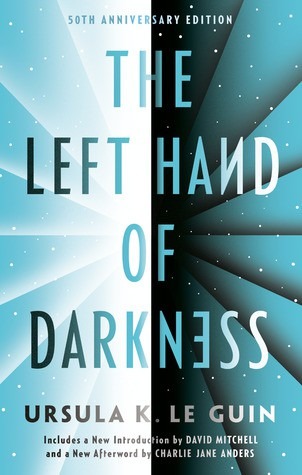
The novel opens with its narrator explaining how he will tell it. Genly Ai, an envoy sent to the planet Gethen, says he will write his report as if it were a story, because he was taught that truth is a matter of the imagination. It is a small methodological aside, and it governs everything after. This is a book that admits, on its first page, that it is an account shaped by a teller. The reader is warned to watch the lens as well as the view.
Then comes a parade in the capital of Karhide, a king laying a keystone, and Ai noticing things wrongly. He reads the people around him as men and women, guesses at their motives through those categories, and misses almost everything. Le Guin lets the error stand in plain, observant sentences. The comedy and the danger are the same: a trained observer who does not yet know what he cannot see.
The architecture
The book is assembled like a dossier. Ai's first-person chapters alternate with other documents: Gethenian folk tales, a religious text, a field note from an earlier investigator of the Ekumen describing Gethenian physiology, and journal entries from Estraven, a Karhidish politician whose motives Ai badly misjudges. No single voice is allowed to own the truth.
The effect is anthropological. A myth arrives and seems like decoration, then, chapters later, it becomes the key to a gesture or a betrayal. The inserted texts teach the reader the culture faster than Ai learns it, so the reader is often slightly ahead of the narrator and anxious on his behalf.
The hinge is the long winter crossing in the second half, where politics falls away and two people are left with weather, rations and each other. The prose slows to the pace of a sledge. It is the most famous stretch of the book, and it earns that by making trust a physical labour, measured in miles.
The theme
Gethenians are ambisexual. For most of each month they have no sex at all; during kemmer they become male or female, with no fixed pattern. Le Guin uses this as a thought experiment, not a sermon. What would a society look like without a permanent division into men and women? She proposes some answers, among them a world with no full-scale war, and lets Ai's discomfort carry the rest.
But the book's real subject is the difficulty of seeing another person clearly at all. Gender is the first obstacle Ai stumbles over; shifgrethor, the Karhidish code of prestige and face, is the second; his own loneliness is the third. The novel suggests that understanding is not a revelation but a slow correction of errors, one mistaken assumption at a time.
Le Guin's sentences support that patience. They are clear and lightly formal, with a fondness for exact nouns, invented words used without fuss and weather described as precisely as politics.
Duality runs through every level, as the title signals: light and dark, Karhide and Orgoreyn, the foretellers' cultivated ignorance and the envoy's mission to know. Le Guin treats the halves as dependent, never opposed.
In the margin
The pronoun is the obvious objection, and Le Guin made it herself. Gethenians are called he throughout, and despite the premise the novel's people tend to read as male: statesmen, soldiers, travellers. In a later essay she defended the choice, then revisited it and conceded the cost. A reader now sees the gap between the experiment and its execution, and the book is more interesting for it. It shows a writer pushing against the limits of her own language and partly losing.
The Orgota chapters also run thin. The bureaucratic second state is drawn in broader strokes than Karhide, closer to a Cold War sketch than to a lived place.
Last note
The Left Hand of Darkness was published in 1969 and still reads as a working model of how speculative fiction can think. It builds a world in order to test a single question, then refuses to answer it cleanly.
What stays is not the premise but the pace of understanding. Two people, a great deal of snow, and the slow discovery that being known by someone else is a kind of shelter.