What a ruined world chooses to keep
Filing note: Filed under art, survival, the before and afterLines underlined: 9
The underlined line
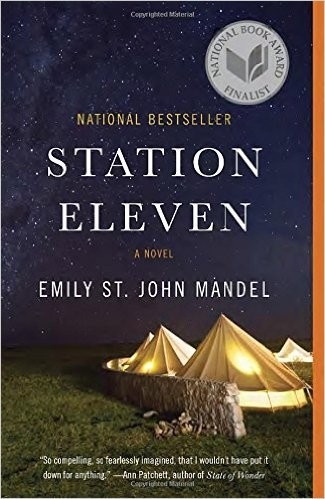
The novel begins on a stage in Toronto, during a performance of King Lear, when the actor playing Lear collapses in the fourth act. A trainee paramedic in the audience climbs up to help. A child actor in the cast is close enough to see it happen. Snow is falling outside. It is a precise, almost theatrical opening, and its placement is the book's first argument. The world is about to end, and Mandel starts not with the virus but with a play: with an audience, a performer and the fragile agreement that holds them in one room.
The prose is clean and unhurried. Mandel writes in short declarative sentences, often in lists of what was lost, and she trusts the plainness. Catalogues of absent things, such as electricity, flight, the internet, the ordinary convenience of a phone, do more work than any scene of panic.
The architecture
The book braids two timelines. One follows the Travelling Symphony, a troupe of actors and musicians moving between settlements around the Great Lakes some twenty years after a flu has killed most of the world. The other moves back through the life of the actor who collapsed on that stage, Arthur Leander, and the people who orbited him: ex-wives, an old friend, the paramedic, the child actor who grew up inside the Symphony.
Mandel moves between the strands by association rather than by clock. An object, a name, a line of text carries the reader from one decade to another. The most important object is a pair of self-published comic books, Dr. Eleven, about a physicist living on a damaged space station. They were made with no thought of an audience, and they travel further than almost anything else from the old world.
The hinge is structural rather than dramatic. Each strand begins to explain the other, and the coincidences that connect them are not cheap; they are the novel's claim that lives touch more than their owners know.
The theme
Station Eleven asks what is worth carrying through a catastrophe. The Symphony's lead caravan bears a line borrowed from Star Trek: survival alone is not enough. The troupe performs Shakespeare to scattered towns because they believe people need more than food and walls. The book takes that belief seriously, and tests it against settlements where it would be easy to stop believing.
Its other subject is nostalgia, examined without sentiment. Mandel's pre-collapse world is not a lost paradise. Arthur's life is glamorous and thin, full of people half-attending to one another. Only after the end does that ordinary, distracted world begin to look miraculous, and the novel is honest that this is partly an effect of distance.
The novel is also precise about scale. It rarely shows the collapse as spectacle. Instead it tracks a handful of people in airports, apartments and hotel rooms, deciding what to do with the next hour. The end of the world arrives as a series of small, private logistics, which is how most people would actually meet it.
Art, here, is not consolation. It is a way of keeping a shared language alive among people who might otherwise forget how to recognise each other.
In the margin
The antagonist thread is the weakest part of the book. A figure whose followers trouble the Symphony gives the post-collapse chapters their tension, but he is drawn more as a type than as a person, and the suspense he supplies feels borrowed from a different, more conventional novel. Mandel is far stronger on mood and connection than on menace.
Some readers will also find the celebrity chapters too long. Arthur's marriages, interviews and parties are deliberately hollow, and the hollowness can be tiring before it becomes meaningful.
Last note
Published in 2014, the novel won the Arthur C. Clarke Award and has since been read through the lens of real pandemics in ways its author could not have planned. That reading is not wrong, but it can narrow the book. Its interest is less in disease than in what endures afterwards: a comic book, a play, a paperweight, a memory of snow.
Station Eleven is an apocalypse novel that keeps looking away from the apocalypse, toward the things people choose to save. The choosing is the story.