Thought experiments that learn to breathe
Filing note: Filed under entropy, free will, patient reasoningLines underlined: 12
The underlined line
The title story is narrated by a being whose body runs on air. Its people breathe from refilled lungs, their thoughts are driven by pressure, and the narrator, an anatomist, decides to understand thinking by looking directly at the machinery that does it. The scene where that investigation begins is written with total calm: instruments arranged, lenses angled, a process described one step at a time. It is a horror premise delivered in the register of a lab notebook.
That register is the thing to underline. Chiang's sentences are plain, declarative and almost frictionless. He rarely reaches for a metaphor when an explanation will do. The beauty, when it arrives, comes from the logic itself, the moment a chain of reasoning lands somewhere the reader did not expect and could not have avoided.
The architecture
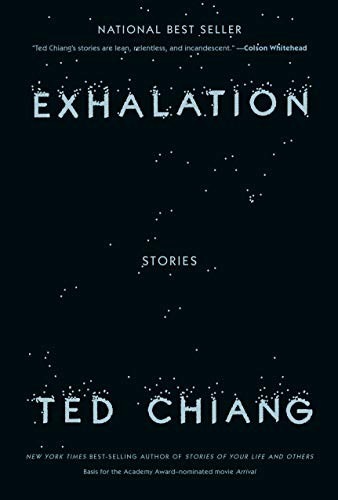
Exhalation collects nine stories of very different lengths. Some are a few pages, like the brief warning that gives its title to What's Expected of Us. Others, like The Lifecycle of Software Objects, run to novella length and cover years. The forms vary too: a nested frame tale in the manner of the Thousand and One Nights, an alternate history written as a scientist's devotional account, a story told partly as a mock museum placard.
What unites them is a method. Each story isolates one premise and follows it with complete honesty. If time travel cannot change the past, what is it for? If a device could prove that choice is an illusion, how would people behave the morning after? If a perfect record of every conversation existed, what would happen to the stories families tell about themselves? Chiang sets the premise, then refuses to cheat. The plot is the premise's consequences, worked through in order.
The book ends with story notes, short paragraphs on where each idea came from. They read like a lecturer's appendix and confirm the impression the stories give: these were thought about for a long time before they were written.
The theme
The collection keeps returning to one question, asked from many directions: how should a person live inside conditions they cannot change? Entropy, determinism, the fixed past, the limits of a body. Chiang's answer is consistently moral rather than heroic. Since the conditions hold, what matters is conduct within them: care, attention, honesty, the decision to keep a promise even when the outcome is settled.
That is why the stories rarely feel bleak, even when their premises are. They are less interested in escape than in grace under constraint. Several of them reach a quiet ethical conclusion that would sound like a sermon in another writer's hands. Here it sounds like the last line of a proof, which is harder to argue with.
The Lifecycle of Software Objects deserves its own note. It follows the slow raising of digital creatures over many years, and its real subject is the unglamorous labour of care: time, money, attention, the patience it takes to let a mind grow. It is the least dramatic story in the book and possibly the most serious.
In the margin
The reservation is the obvious one. Chiang's people are often vehicles for his ideas. They speak in the same clear, reasonable voice, they explain their feelings precisely, and they rarely surprise the story that contains them. Readers who want characters with contradiction and appetite will find the cast thin.
The prose, too, can feel too clean. There is little texture of place, little humour, few sentences that exist for their own pleasure. The novella in particular asks a great deal of patience for a story told in such an even tone. A collection this disciplined occasionally reads like a set of very good essays that have agreed to wear fiction.
Last note
What stays is the decency of the reasoning. Chiang takes speculative fiction's oldest move, the what-if, and slows it down until it becomes a way of thinking about responsibility. The premises are vast: the end of a universe, the impossibility of choice. The conclusions are small and personal, which is exactly why they hold.
Read the title story twice. The second time, notice how much of its feeling lives in the narrator's insistence on describing the method correctly.