A border drawn inside the eye
Filing note: Filed under borders, perception, the unseenLines underlined: 10
The underlined line
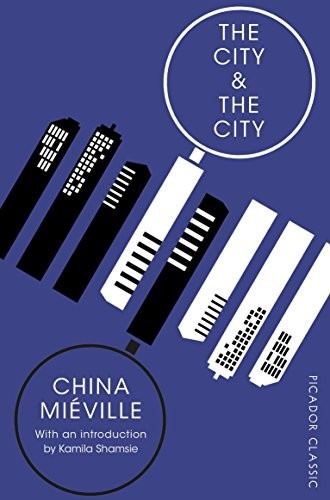
Early on, Inspector Tyador Borlú passes an elderly woman in the street and realises, a beat too late, that she is not in his city. He has seen her. He must now unsee her: let his gaze slide off her coat, her gait, her shopping, as if she were weather. The moment is brief and wholly ordinary to him, and it is the most unsettling thing in the opening chapters. Miéville's premise does not arrive through exposition. It arrives through a reflex.
That is the book's method at the sentence level. Borlú narrates in a clipped, procedural first person, full of jargon he never pauses to explain. Terms such as crosshatched, grosstopical and unseeing are used as if the reader already knows them. The reader learns the rules the way an immigrant learns a city, by watching locals and copying them.
The architecture
The cities are Besźel and Ul Qoma, two states occupying much of the same physical ground somewhere at the eastern edge of Europe. Some districts belong wholly to one city, some to the other, and many are crosshatched, shared street by street, sometimes building by building. Citizens of each are trained from childhood to ignore the other city around them. Crossing is legal only through an official checkpoint, and a shadowy power called Breach punishes anyone who crosses in any other way.
Onto this Miéville lays the frame of a police procedural. A young woman is found dead on an estate in Besźel, and Borlú's investigation keeps tugging him toward Ul Qoma. The book is divided into three parts, and each one shifts his relationship to the border. The procedural is not decoration. Its rhythm of interviews, paperwork and jurisdiction disputes is exactly what makes the impossible geography feel bureaucratically real.
Miéville keeps the world-building almost entirely in the background. There are no maps, no historical prologue, no lecture on how the split began. Scraps of history surface in conversation, in academic disputes, in the jokes of police officers, and the reader assembles them. The restraint is a structural decision: the less the cities are explained, the more natural their strangeness feels.
The hinge is a change of vantage. When the investigation crosses over, the reader sees the first city as the second city sees it, and the familiar streets turn strange.
The theme
The City & the City is about borders that exist because people agree to obey them. There is no wall between Besźel and Ul Qoma, only habit, fear and law. The novel's sharpest insight is that this is not fantasy at all. Every city has neighbourhoods its residents learn not to see: the poor, the foreign, the inconvenient. Miéville takes that quiet social skill and makes it literal, then asks what it costs to maintain.
It is also a book about noir as a way of seeing. The detective's job is to notice what others miss. Here the whole culture depends on not noticing, so the investigator's instinct becomes a kind of danger. Borlú is a good policeman precisely to the degree that he is a poor citizen.
In the margin
The puzzle is less interesting than the place. Once the solution of the murder begins to come into view, it feels more conventional than the world that frames it, and the closing stretch trades some of the earlier ambiguity for momentum. Readers who arrived for the ideas may find the final reckoning tidier than the premise deserves.
Borlú himself stays thin. His voice is distinctive, but his inner life barely registers beyond professional fatigue. That suits a noir narrator; it also leaves the emotional weight of the book with the cities rather than the people in them.
Last note
The novel won the Hugo, the Arthur C. Clarke and the World Fantasy awards, an unusual sweep for a book that barely uses the furniture of any of those genres. It contains no magic, no technology and no explanation. What it has is a single idea, worked out with procedural patience.
Finish it and the habit transfers. Walking through any real city afterwards, a reader starts to notice what the eye has been trained to skip.