Every city a way of remembering
Filing note: Filed under memory, desire, imagined citiesLines underlined: 14
The underlined line
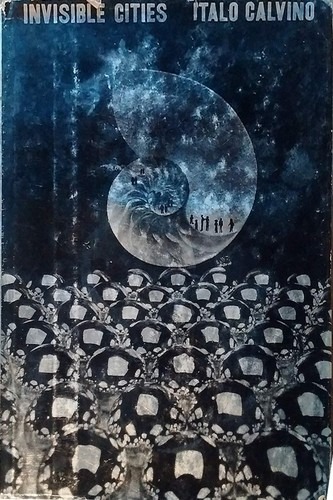
The city of Zaira, in Marco Polo's telling, does not recite its past. It holds it, the way a hand holds its lines, in the gratings of windows, the banisters of steps, lightning rods and flagpoles, each one scored with old marks. Read that passage once and the method of Invisible Cities is clear. A city is not described; it is proposed. Each one is a single idea pressed into architecture, and the description is a short, exact working-out of what that idea would look like if people had to live inside it.
William Weaver's English keeps Calvino's sentences light and precise. They are built from lists, qualifications and sudden reversals, and they move with the calm of someone explaining a geometry problem. The beauty of the book is never ornamental. It is the beauty of a clean proof.
The architecture
The book has two layers. In italic frame passages, Marco Polo and Kublai Khan talk: about the empire, about whether the cities exist, about the limits of description itself. Between those frames sit fifty-five short city portraits, each named for a woman, each filed under one of eleven headings such as cities and memory, cities and desire, thin cities, trading cities, cities and the dead.
The headings rotate through the nine sections in a strict, staggered pattern, so that each theme enters, recurs and departs on schedule. The arrangement is mathematical, almost a sequence, and it rewards a reader who maps it in the margin. Calvino was close to the Oulipo writers, who treated constraint as a generator of invention, and the book shows that influence everywhere. The rigid scaffold is what allows the individual cities to be so free. Inside each small box, anything can happen, and the box makes it legible.
The frame dialogues are the hinge. They begin as courtly exchanges and gradually become a philosophical argument about whether any account of the world can be true, whether the Khan's empire is an empire of things or of signs, and whether the traveller is describing places or himself. Late in the book a quiet admission recasts everything that came before: these cities may all be versions of one city the traveller cannot stop describing.
The theme
Invisible Cities thinks about how human beings make places out of desire and memory, and how places, in turn, make them. A city strung with threads between its houses until the inhabitants can no longer move. A city suspended over an abyss on a net, whose people know exactly how long the net will last. A city that throws itself away each morning and wakes under its own refuse. Each is a parable, but none is moralised. Calvino trusts the image to carry the argument.
Beneath the play sits a serious claim about cities as minds. Every portrait is also a portrait of a way of thinking: hoarding, forgetting, longing, ordering, fearing the dead. The book reads, in the end, as an atlas of consciousness drawn as if it were urban planning.
In the margin
A book this crystalline can feel cold. Without characters in the usual sense, without plot, without scenes that unfold in time, Invisible Cities asks the reader to supply all the warmth, and some readers will not. The cities are also uneven. A few are dazzling, a few feel like variations on a theme already played, and reading straight through risks a kind of exquisite fatigue.
The answer is probably to read it the way it was built, in short sittings, a section or a heading at a time, with pencil in hand. It is less a novel to finish than a set of drawers to open.
Last note
The final frame passage turns from description to ethics, from what cities are to how one ought to live inside the bad ones. It is the only moment the book raises its voice, and it lands because everything before it has been so composed. After fifty-five imaginary places, the question becomes plainly practical.
Invisible Cities is a small book with a large shadow. Architects quote it, poets steal from it, and it remains one of the clearest demonstrations that structure itself can be a form of feeling.