A marriage kept in fragments
Filing note: Filed under marriage, fragments, the art monsterLines underlined: 11
The underlined line
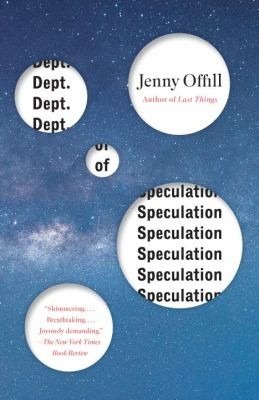
Early in Dept. of Speculation, the narrator explains what she had planned instead of marriage: she was going to be an art monster. The phrase is funny, a little grandiose, and exactly calibrated. It names a type, the artist who sacrifices everything and everyone for the work, and it admits in the same breath that the narrator is not that type, or no longer gets to be. Most of the book lives in the gap between that ambition and the life that arrived in its place.
The line also shows how Offill builds a sentence. Plain diction, one surprising word, a full stop. Then white space. The next paragraph might be a fact about astronauts, a remark from a philosopher, a joke, or a memory of a fight. The reader supplies the connection, and the connection is where the feeling lives.
The architecture
The novel is made of short blocks of prose, sometimes a single sentence, separated by space. It reads like a notebook kept by someone too tired and too clever to write in paragraphs. The title comes from the couple's early letters to each other, addressed to a mock department, and that playful private register sets the tone: this is a marriage seen from inside its own jokes.
The fragment form is not decoration. It is how a life with a newborn feels, interrupted, sleep-deprived, assembled from scraps of attention. It is also how memory works under stress: one bright detail, then a jump. Offill lets the gaps carry time. Years pass in a line break. A whole season of illness or doubt can be compressed into three sentences, and the compression is the point: this is how a crowded life is actually remembered.
The hinge is a change of grammatical person. Partway through, the narrator steps back from herself, and the pronouns shift. The move is quiet and devastating. Distance enters the prose at the exact moment distance enters the marriage, and the reader feels it before understanding why. It is one of the cleanest structural decisions in recent fiction: a crisis registered in grammar rather than announced in plot.
The theme
The book thinks about two kinds of devotion that do not fit neatly in one apartment: devotion to work and devotion to people. The narrator teaches, takes on writing for hire, tries to finish a second book, loves her daughter fiercely, and resents the way love eats time. Offill refuses to resolve that tension into a lesson. Both pulls are real. Neither wins cleanly.
Marriage here is less a romance than a long collaboration under pressure, full of small kindnesses and petty failures. The quotations scattered through the text, from poets, scientists and philosophers, work like the narrator's handholds. She reaches for borrowed wisdom when her own gives out, and the book is honest about how little the borrowed wisdom sometimes helps.
The humour matters. Offill is very funny, in a dry and self-lacerating way, and the jokes are not relief from the sadness but part of its texture. People in trouble are often at their wittiest.
In the margin
The fragment form has a cost. Its brightness can tip into preciousness, and a few of the borrowed facts feel chosen for their gleam rather than their pressure. A reader who wants the husband rendered with the same depth as the narrator will be disappointed; he stays largely an outline, glimpsed through her moods. That is defensible, since the book is a record of one consciousness, but it leaves the central relationship lopsided.
Its brevity also invites speed. The book can be read in an afternoon, and the danger is reading it like that, skimming the white space instead of sitting in it.
Last note
Dept. of Speculation proves that a novel can be built from what a mind keeps when it cannot keep everything. The fragments are not the wreckage of a story; they are the story's chosen form, and the gaps between them are as composed as the sentences. Offill writes about domestic life without softness and about ambition without vanity.
The notebook, in her hands, becomes a way of thinking under pressure. Short entries. Long silences. Every space doing work.