A self drawn by everyone else
Filing note: Filed under listening, self-erasure, conversationLines underlined: 9
The underlined line
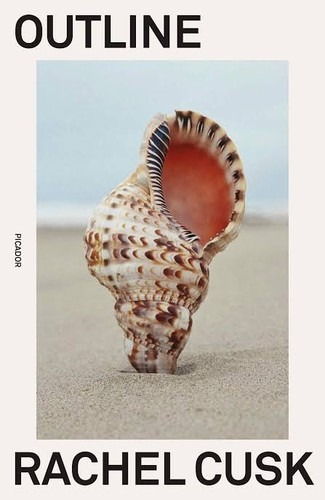
The first conversation in Outline happens on a plane, between a narrator who has just sat down and the man in the next seat. He talks; she asks. By the time the plane lands in Athens, the reader knows the shape of his marriages, his boats, his grievances and his self-regard, and knows almost nothing about her. That imbalance is not an accident of the scene. It is the method of the whole book, announced in its opening pages and never abandoned.
What gets underlined first is not a line of hers but the way her questions are built. They are short, level and almost blank. They give the other person room, and the other person fills it, usually with more than they intended. Cusk writes these exchanges in reported speech far more than direct dialogue, so every confession arrives already filtered, slightly cooled, held at arm's length by the narrator's syntax. The effect is a strange intimacy: overheard rather than shared.
The architecture
The novel runs in ten conversations. A neighbour on the flight, a friend at a dinner, students in the writing workshop she has come to teach, a fellow writer, a publisher. Each chapter is a room the narrator walks into and listens in. There is barely any plot to summarise and the book knows it; momentum comes from the accumulating pattern, not from events.
The structural trick is that these monologues are never really about their speakers alone. Each one is a theory of living: of marriage, of failure, of how a story should be told about the self. Placed side by side, they begin to argue with one another. One speaker believes in narrative as rescue; another believes narrative is the lie that keeps people from changing. The narrator says almost nothing in reply, and her silence becomes the book's sharpest position.
The workshop chapters are the hinge. Asked to tell a story about something they noticed on the way to class, the students produce small, revealing set pieces, and for a moment the novel watches its own method from the outside. Teaching is listening with a purpose. So, it turns out, is fiction.
The theme
Outline is about what remains of a person once the usual autobiography is withheld. The narrator is recently separated, raising children elsewhere, unmoored in a hot city. Those facts surface sideways, almost reluctantly. She is defined less by her own account than by the contours other people press against her.
That is the title's quiet argument. A self can be known by its outline, the edge where other lives meet it, rather than by its interior. Cusk takes the idea seriously enough to build a novel on it, and the result is both a formal experiment and a genuinely unsettling claim about identity: that perhaps there is less inside than we pretend, and that the pretending is the story.
A sentence-level note: Cusk's paragraphs are long, clause-heavy and patient. They resist the quick, quotable flourish. Insight arrives as a slow turn at the end of a paragraph, when a speaker's anecdote suddenly reveals the opposite of what they meant it to. The prose rewards rereading because the turns are easy to miss the first time.
In the margin
The objection writes itself, and many readers have made it: everyone in Outline sounds like Rachel Cusk. The Greek shipowner, the novelist, the young student all speak in the same measured, analytical register, with the same appetite for abstraction. Realism is not the aim, so this is partly a category error. Still, the uniformity flattens some chapters. When every speaker is equally articulate about their own psychology, the book's central contrast, a silent listener among talkers, loses a little of its edge.
There is also a coolness that some will read as evasion. The narrator's withholding is principled, but principle can look like hiding. The novel invites that suspicion and does not fully answer it.
Last note
The book's real subject is attention. It asks what happens when a person stops narrating and simply listens, and it finds that the world rushes in to fill the space, often with more candour than conversation usually allows. Outline is the first of a trilogy, and it reads like a manifesto for the other two: a proposal that the novel can be built from other people's voices, with the author standing just out of frame, listening hard.
Close the book and the narrator is still mostly a blank. That is the point. The blank has a precise and well-drawn edge.